Making Noise
From garage to stage: Michael Gaedt and Eric Scaggiante's roaring FEUERSTÜHLE

Within our Contemporary Rituals column, we trace how creative practices unfold not only as objects, but as gestures repeated, activated, and shared. FEUERSTÜHLE enters the column at a precise moment: after its opening on February 6 at Galleria Montegani, and just before its final transformation on February 24, when the exhibition will culminate in a live performance.
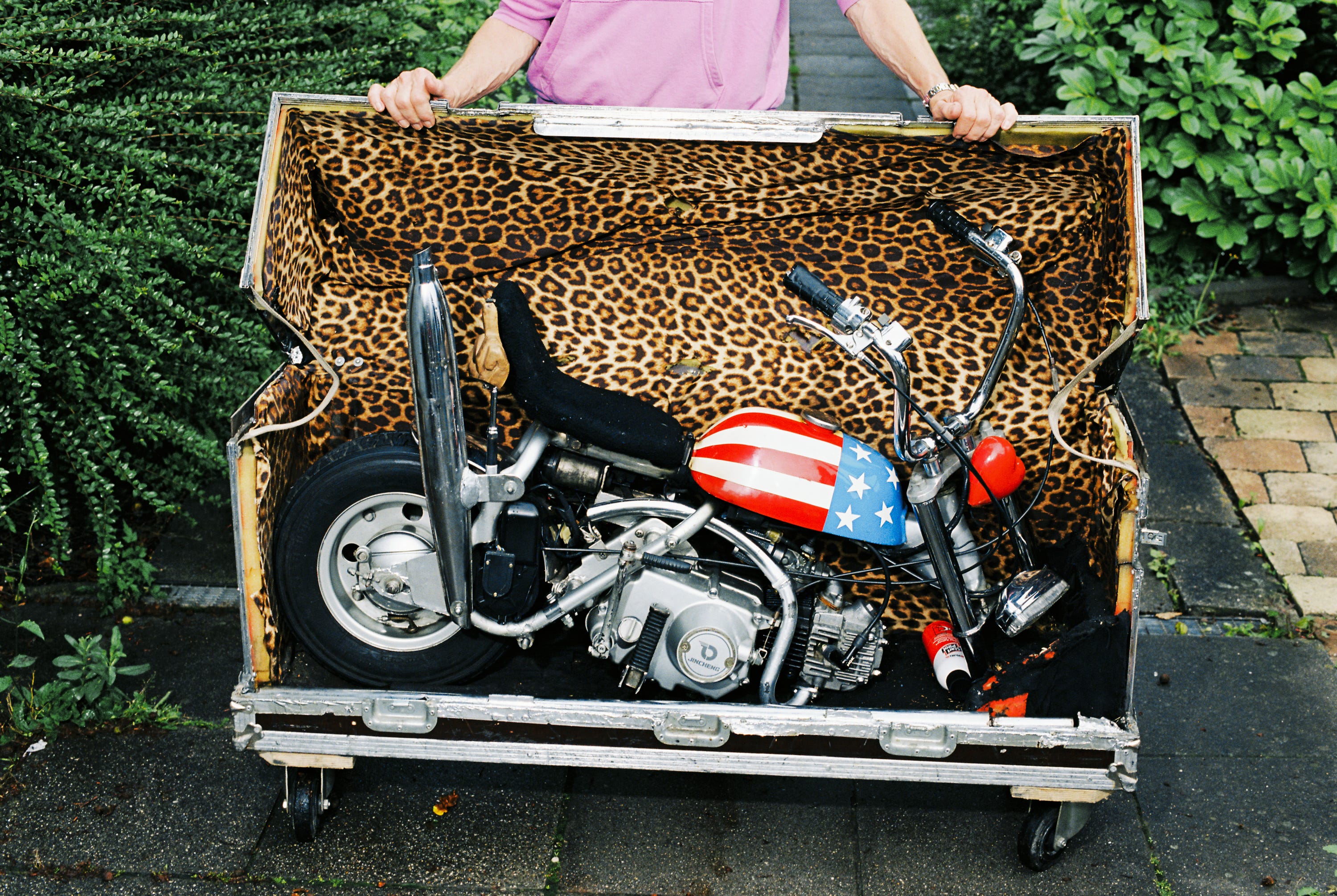
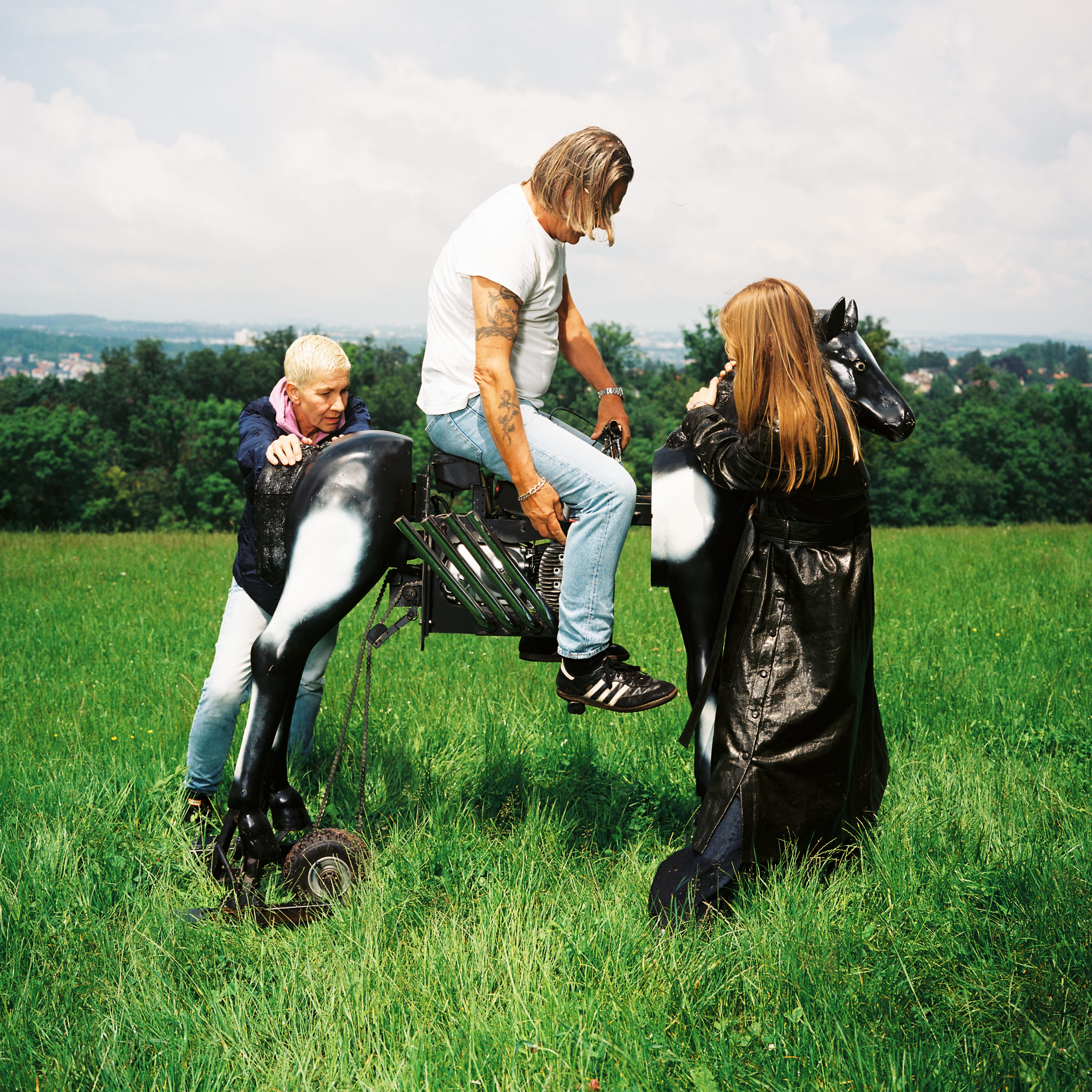
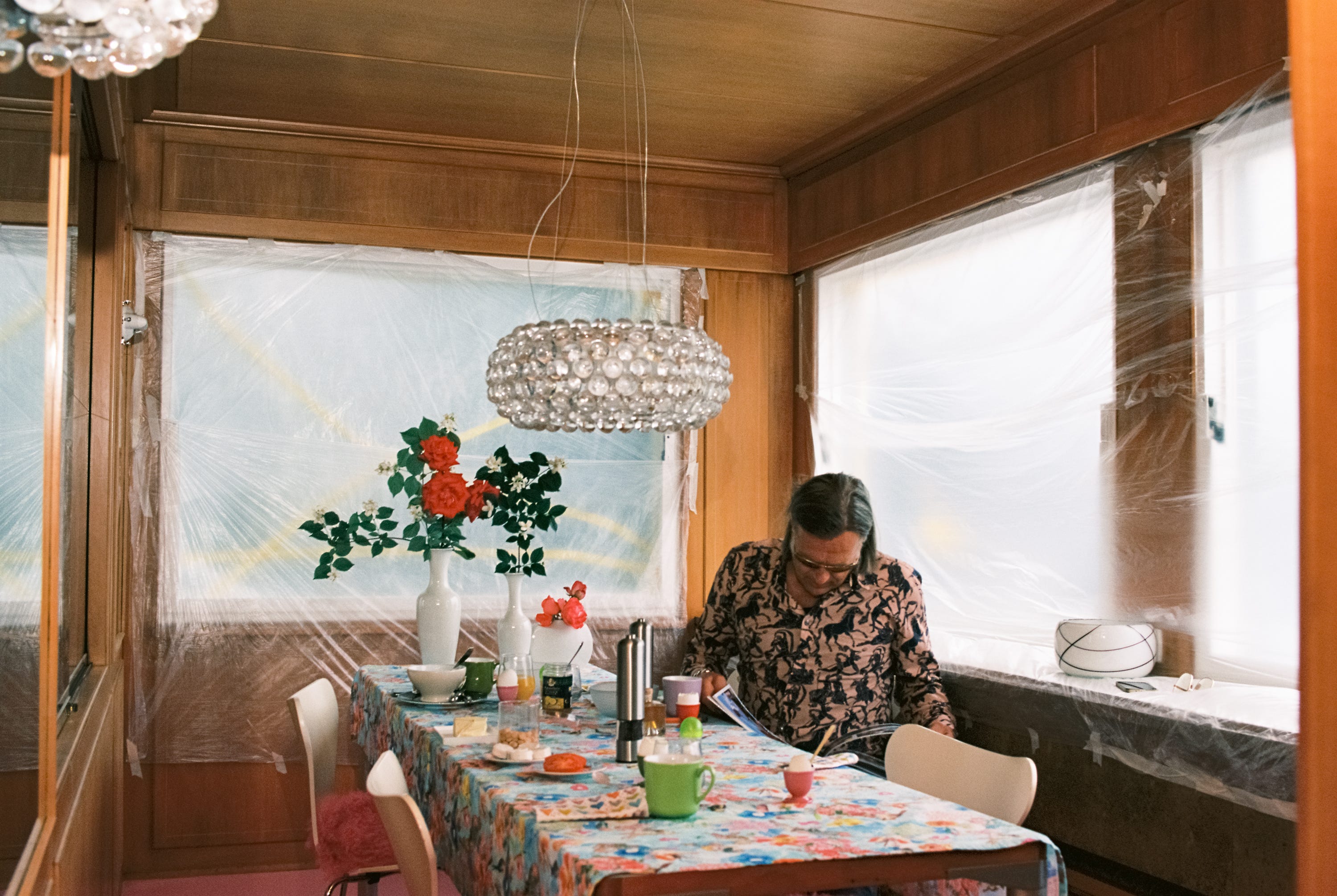
The project brings together the motorized constructions of German artist Michael Gaedt and the photographic works of Italian photographer Eric Scaggiante. For over forty years, Gaedt has been adding horsepower to unlikely objects, bumper cars, wheelbarrows, carousel horses, first in his Stuttgart garage and later on stage with his band Die Kleine Tierschau, performing more than 4,500 shows between 1981 and 2016. In the gallery, these engines are temporarily stilled and recontextualized as sculptural artifacts. Scaggiante’s images, shot in and around Gaedt’s studio, oscillate between documentation and surreal portraiture, capturing both the mechanical force and the childlike imagination that power them.
We spoke with Gaedt and Scaggiante in the days between exhibition and performance, at a threshold moment when the work exists in suspension. In this conversation, we discuss repetition, activation, and what changes when objects built for noise are first silenced and then prepared to roar again.
Your practices begin with very physical gestures: building, assembling, and photographing. What is the first ritual that opens your working day?
Michael: Taking the dog on a one-hour walk from home to my workshop.
Eric: Switching on the radio, brewing a moka on the fire.
FEUERSTÜHLE brings together machines that roar and machines that click. Where do your two creative processes truly meet?
Michael: Temporally, Eric’s creative process begins once mine is completed. Completed a long time ago, actually, in some cases (seeing that some objects in the show I built up to 40 years ago). The way we worked together here reminds me of a baton exchange in track and field. Eric is about to hand the baton back to me in this case, on the 24th of February, for the live performance.
Eric: The baton exchange is a good metaphor. By the way, i consider my creative process as “passive” i don’t consider myself as a creator that brings together things in order to create something new but i’m more an eye, that throughout the medium of “photography” tells and show something that exists but was not seen by others, so i try to bring the the spirit that got my attention to others via photography. While Michael has a totally “active” creative process, he constantly brings new things, ideas, objects, words, sounds, and machines to the world. I think our meeting point is the enthusiasm we have for each other’s practice, and that's where we also meet everybody who likes that object or pic as much as we do.
The exhibition concludes with a finissage performance on February 24. How does the work change when it moves from display to activation in time?
Michael: The machines were never built with an exhibition in mind; they’re usually always in motion during my shows. We’ve sort of put them into hibernation and are now waking them up so they can be their noisy selves again.
How much space do you leave for error, accident, and childlike play within your work today?
Michael: I start off with an image in my mind and no plan, no instructions, no sketch of how I will get to that result. The process then kind of takes shape as it goes. So there can’t really be any errors or accidents because nothing’s planned ahead. Just that sometimes detours happen that elongate the process. There’s always just one direction, never turning back.
Eric: I’m a bit fatalistic in my life. I like to find the flow and follow it like kayaking on a rapid, keeping the control on me but absolutely not trying to control what’s around me; let the things flow around you, and, if you want, you flow with them. Childlike play or spirit is crucial. Kids make a lot of mistakes, but they are just fine with that; every mistake is an achievement to them in some way. In general, I’m open to errors; it is just important not to stop at the error and go forward without repeating it too many times. On the job it’s a bit different, I don’t like to feel anxious or having people blaming me for mistakes, so in that environment i prefer to play safe and relax.
Can making something “useless” still be understood as an act of freedom?
Michael: Any creative process starts with freedom for me. Everything material surrounding us was art at its very genesis. Electricity had its debut at the World Expo in Paris, not in the technology exhibition but in the art exhibition. And in the German Renaissance, think Albrecht Dürer’s time, there was a massive gear mechanism that was called “Die Große Kunst” (the big art), not the big mill wheel or whatever functional purpose it served. Something developed with complete freedom can turn out to be very useful.
Eric: If these useless things free you and make you feel good, I think it is absolutely an act of freedom. Do something that nobody asks you to do, just because you need to.
This project is rooted in family, friendship, and collaboration. What kind of temporary community has formed around FEUERSTÜHLE?


Michael: The project itself was made possible thanks to a group of people coming together with respect for each other’s work. Then, at the exhibition, the objects kind of found their audience as they did in my shows, with visitors pointing at them and observing them closely, full of curiosity.
Eric: I think everybody in the team was really, really crucial for the realization of this exhibition and experience. I’m not used to teamwork like this, but this time it taught me a lot.
Do you imagine the exhibition space more as a garage, a stage, or a meeting place?
Michael: A stage.
Eric: A garage, an inner garage where you keep part of your stuff; then you open it to some others, and at that point it also becomes a meeting place and a stage if you feel like tidying up your garage before people see it.
What role does the audience play once the work becomes performative?
Michael: The most important role, always way more crucial than any instrument, prop, or gesture from my side.
In your work, childhood appears not only as memory but as method. What does it mean to remain faithful to that impulse in adult life?
Michael: A child is not aware of its childishness, and neither am I, really, able to answer this question. I don’t know.
Eric: I don’t think childhood and inner kindness is a method that you switch on and off, I think it’s more a necessity to keep alive to free ourselves from the prison of canonical rules, and at the same time being adult is to free the kid we were in our childhood from the lack of experience. Being an adult in the end should be being an experienced child, maybe :)
Noise and silence coexist throughout the project. Which one truly allows us to listen?
Michael: It’s lovely to see the works being completely silent in the exhibition because you can tell how noisy they can be just by looking at them. So it’s more of an expectation of noise.
Eric: Both, because without one of them, you could not even know what it means to listen. It’s always about contrast, silence-noise, bright-.dark, sweet-bitter. No contrasts, no feelings. You listen completely, listening to both.
What question or feeling do you hope visitors take away after the performance on February 24?
Michael: They should just have a good time.
Eric: I hope they don't fall into the error of questions.